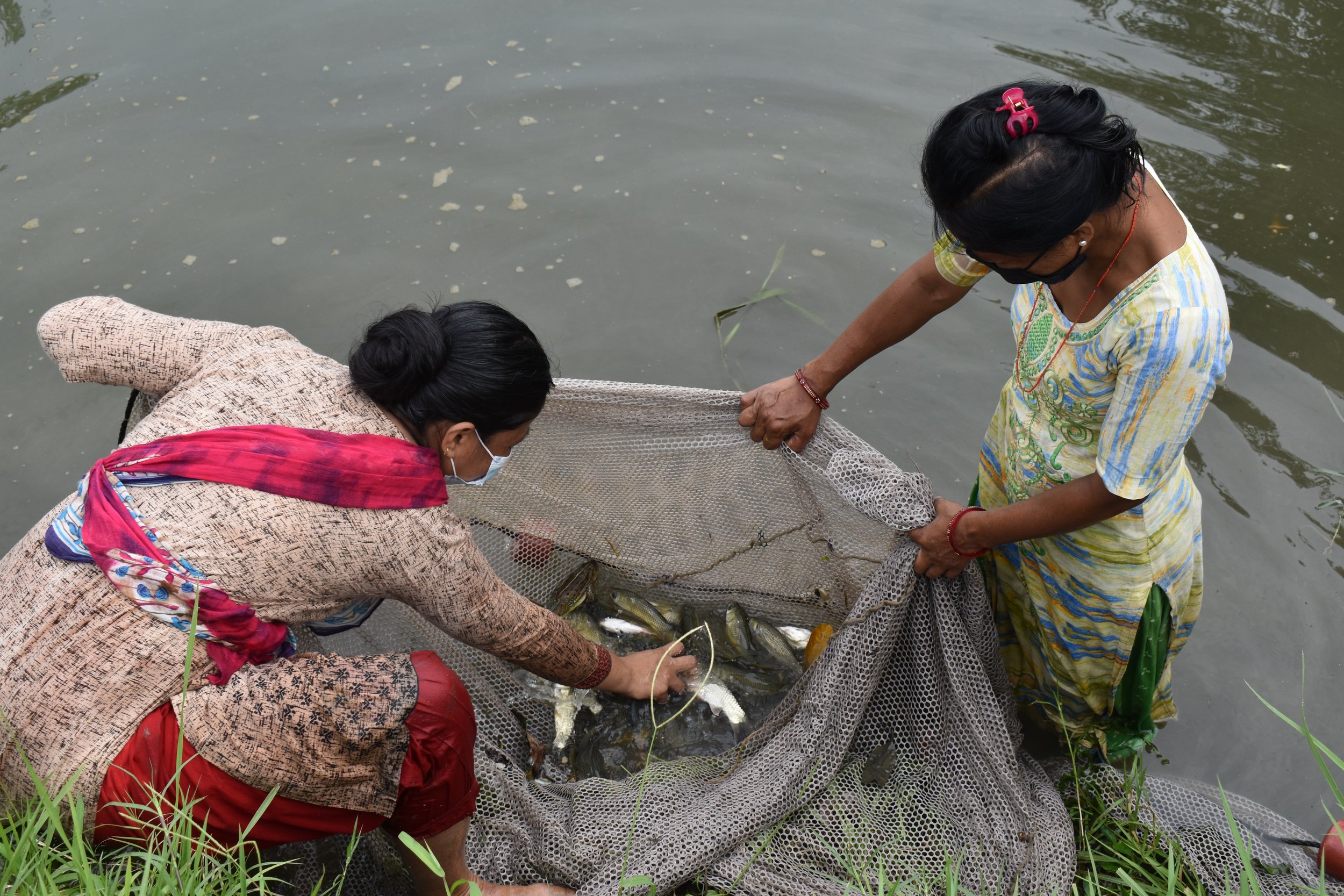
Developing Women Entrepreneurship and Climate Change Resilience in Nepal amid COVID-19 and Natural Disasters

The Nepalese economy is highly dependent on its agricultural sector, which engages over 65 per cent of the population. The sector is, however, very vulnerable to disasters and impacts of climate change, including floods, droughts, landslides and intense rain. Food security is therefore highly negatively affected and the livelihoods of marginalised groups like women are, in turn, at risk. The forestry and fish-farming sectors in Nepal are traditionally male-dominated sectors where women’s roles and voices are quite limited. Comprehensive approaches to building resilience for livelihoods development in the forestry and fish-farming sectors are necessary and this also includes the empowerment of women.

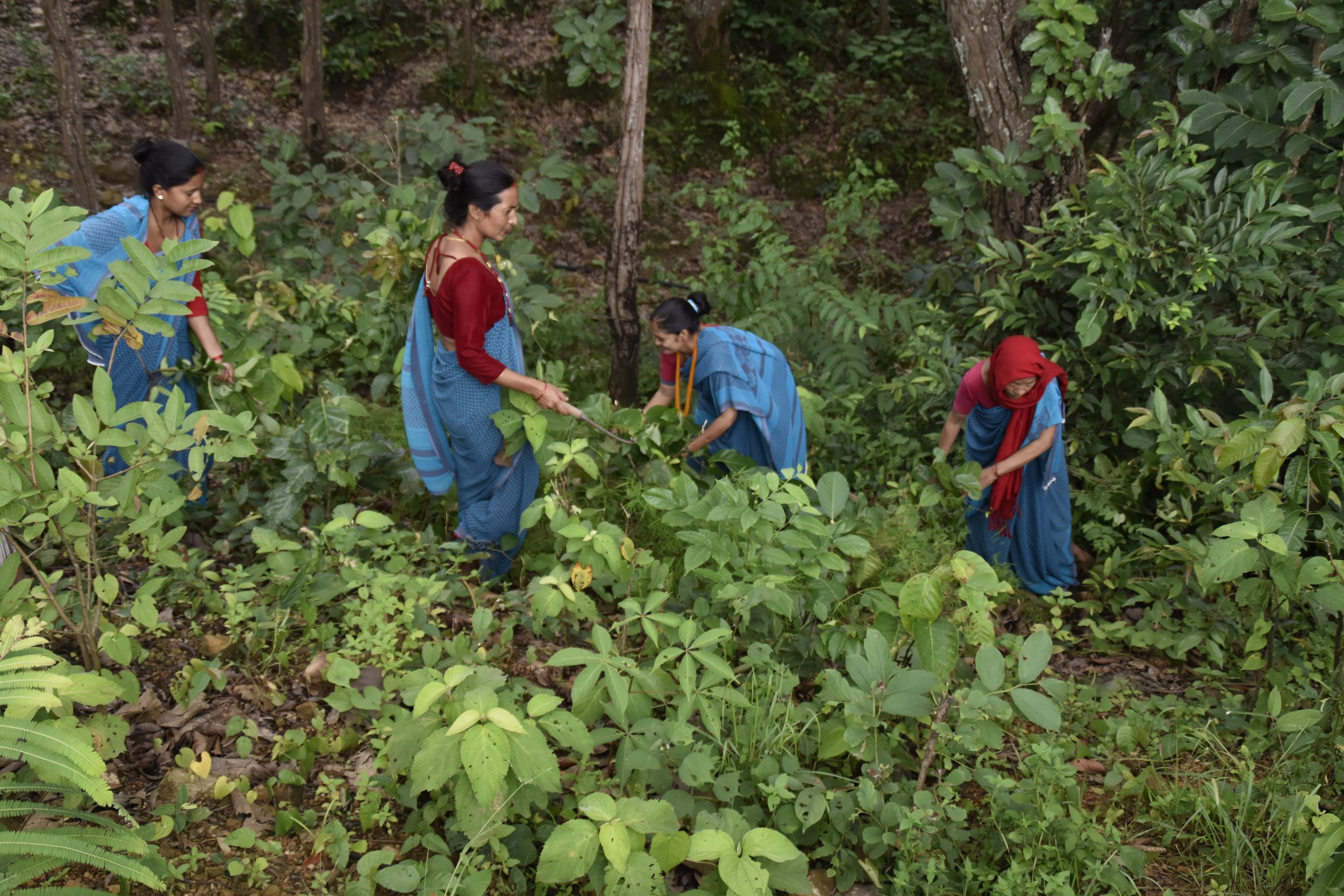
The year 2021 has marked the first year of operations of the ‘Women for Entrepreneurship and Resilience’- transforming fish-farming and forest value-chains’ project in Nepal. This four-year collaboration between the Federation of Community Forestry Users (FECOFUN), Sundardeep Women’s Fish-farming Cooperative (Sundardeep), Amritpur Social Entrepreneur Cooperative Ltd. (ASEC) and the Finnish Agri-Agency for Food and Forest Development (FFD) aims to enhance women’s income generation, entrepreneurship and livelihoods resilience. The main project focus is to develop resilience to climate change and disaster-risks, by developing climate-smart production, income generation and community-based enterprises, in three regions of Nepal: Dang, Chitwan and Nawalparasi.

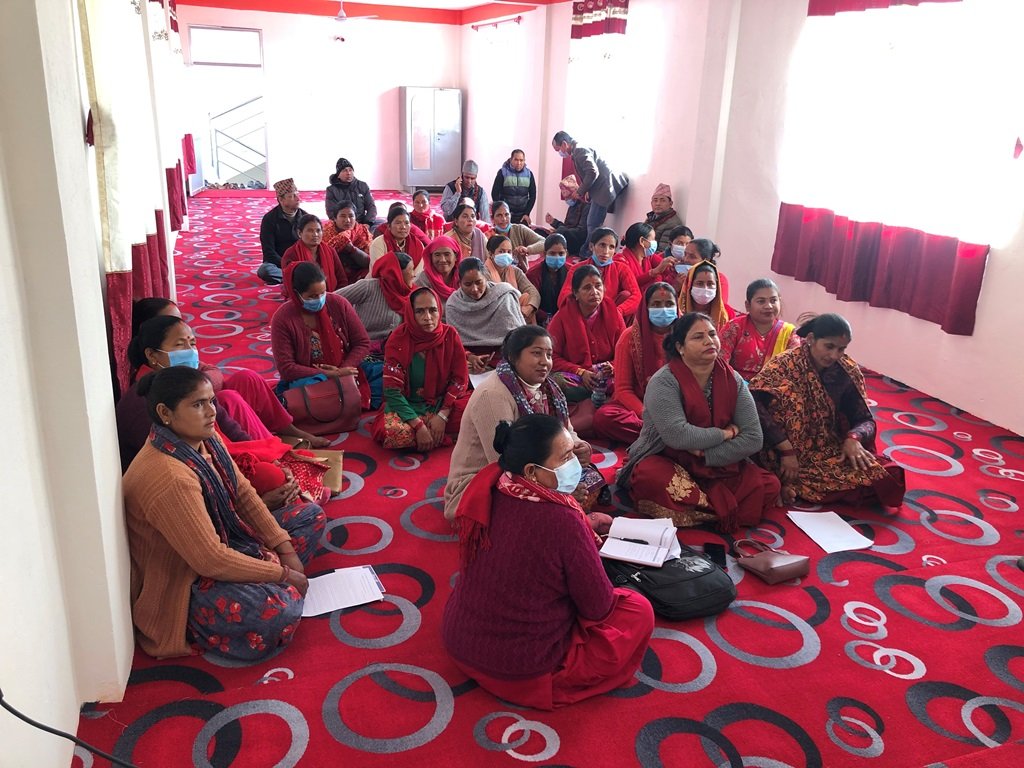
The beneficiaries consist of 18 farmer organisations that have committed to gender equality and enhancing services directed to women and enhancing advocacy of their total 1200 women members, with this advocacy support indirectly reaching over 6000 persons. All the three organisations have collaborated with FFD in the past, whereby the development of women groups and cooperatives has been supported. There is, therefore, already a strong foundation for the current collaboration, to build on.

However, initiating the activities in the midst of a pandemic has certainly not been easy. In Nepal, there have been strict restrictions of movements between and within regions. This has made it very difficult to organise meetings and gatherings necessary for instance trainings, or even for gathering of information needed for making an in-depth analysis of the climate and disaster risks for each region involved, and sector-wise for the forestry and fish-farming sector. The pandemic has enhanced a digital leap, just like in many parts of the world.  Although Zoom meetings have become part of the norm, connectivity, electricity cuts and digital literacy remain a huge challenge. Digital tools cannot still be solely be relied on, to implement the activities on this project.

 Simultaneously, there have been climate-related incidences that have made it challenging to initiate the project activities. This year, about 65 hectares of forest in the forest areas, occupied by the community forest user groups supported in the Dang region, were lost to forest fires. This led to the making of monitoring plans for forest fire sensitive areas. The community forest user groups, especially women, however, continue to fear new forest fires. The monsoon season also started earlier this year, already in June. Massive floods and landslides in the Chitwan and other districts of Nepal, resulted in human casualties, damage to infrastructure, and harvest losses. In addition, people lost livestock and their homes, and the incessant rainfall resulted logistical problems, when roads and bridges being damaged. Fish-farming also suffered when damage to fishponds occurred and fish mortalities occurred.  

Women tend to greatly experience fear and anxiety in these situations, fearing for the lives of their children, their parents and larger extended family and, for themselves. Pre-existing hierarchies and inequalities in access to resources, capabilities and opportunities make vulnerable groups even more vulnerable, a never-ending vicious circle. The needs of rural women are thus, important to consider when creating response, readiness and recovery strategies.

The project’s aims are being achieved through a co-creation model, where women’s perspectives are taken into account. A participatory climate and disaster risk assessment was conducted in the second half of 2021, and its resulting recommendations will be implemented in 2022. These, among others, include building on the indigenous knowledge of local communities and integrating this knowledge and local practices in sustainable forest management, raising awareness of local communities on how to access resources for climate change mitigation and disaster risk management, and making early warning systems accessible to local communities.

Some mitigation measures have already been put into place, for example, FECOFUN, with provincial officials, organised a workshop for women members of Sundardeep and ASEC to share information about legal provisions for the enhancement and developing of women’s capacity. In addition, the women were provided information on provincial government grants and programmes for enhancing women entrepreneurship. In ASEC, a routine plan for forest fire monitoring was developed for six community forest user groups and is now in active use. In Sundardeep, 86 women fish farmers received support in the preparation of their fishponds, whose dykes were built to withstand floods better. Furthermore, women fish-farmers were also provided information on how stresses from flood and drought impact fish health in carps and how to mitigate these stresses, through regulation of oxygen levels and proper water management techniques.

The coming year 2022 will still present challenges in terms of the ongoing COVID-19 pandemic. However, the lessons learnt in 2021 can help in planning the activities better and more effectively. The three partners FECOFUN, Sundardeep and ASEC have, at the end of 2021, discussed on their 2022 plans and activities. One main aim is to better facilitate effective and constant communication between the beneficiaries, allowing them to exchange information and learning. Although, encompassing three different geographical regions and two different agricultural sectors, the women can definitely learn from each other, and the project provides a platform through which social learning can be utilised in creating sustainable strategies for climate change related response, readiness and recovery, to create better and improved social safety nets and improved livelihoods in the project regions. 

Roseanna Avento, Kobe Global

Twinning Partner Representative Finnish Fish Farmers’ Association


The project: ‘Women for Entrepreneurship and Resilience - transforming fish-farming and forest value-chains in Nepal’ is funded by the Ministry for Foreign Affairs of Finland from 2021-2024

Increased Sustainability with Training and Storage

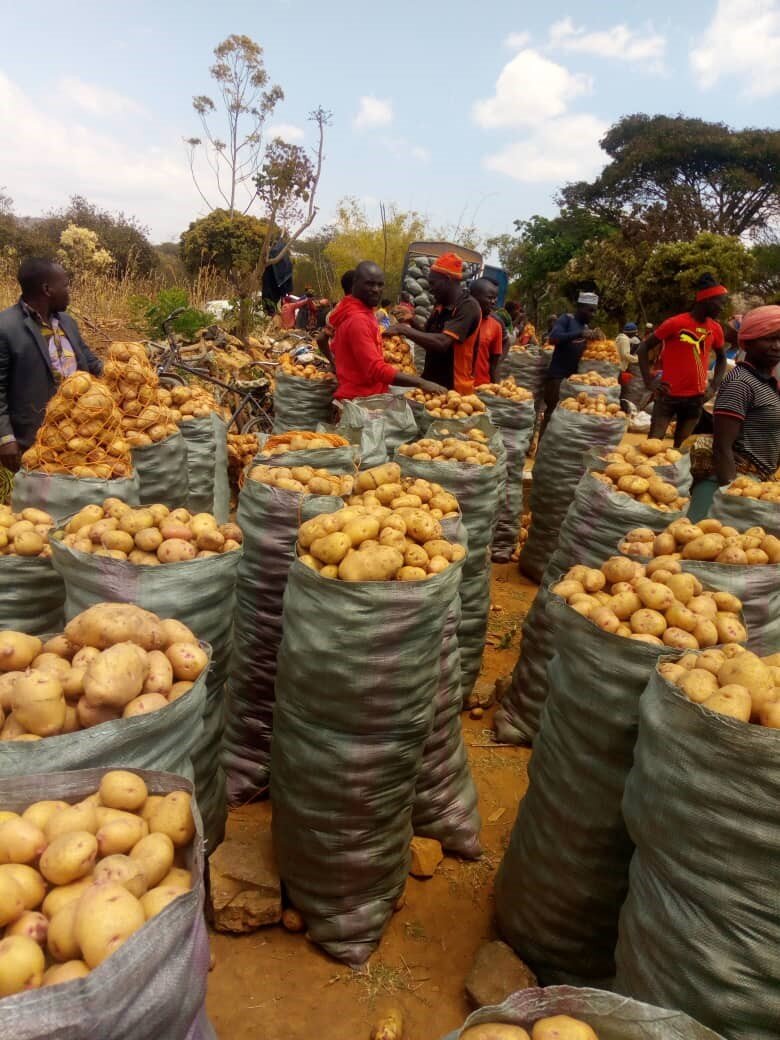
Huruma Mgaya, a smallholder in Tanzania, has been a member of Tanzania’s Njombe Agricultural Development Organization (NADO) since 2016. She is also the secretary of UMOJA ‘A’ group in Itunduma village in NJOMBE DC. Huruma has been farming potatoes for 5 years and through NADO has learned about sustainable farming. She has learned new skills by attending NADO’s training workshops in Good Agricultural Practices (GAP), Farm Business School (FBS) and Good Post-Harvest Handling (GPHH). After implementing what she learned in the training sessions, Huruma’s potato production has increased (from 4-6 MT/acre to 8-9.5 MT /acre) and so has her income.

Huruma built a small storage for her potatoes so that she can keep them up to 4 months without affecting their quality and taste. The storage also reduces her post-harvest losses. Due to price fluctuations, she used to leave matured potatoes in the field for a long time while waiting for prices to increase. This led to lower quality potatoes and waste as she had to throw some of the potatoes away. Now she can store her potatoes and decide when to sell the potatoes depending on the market price.

Huruma in front of her storage in Tanzania

Huruma Mgaya built a potato warehouse so she can store the potatoes longer, sell them at a better price and reduce food waste.

Mozambique: Corn storage and milling possibilities increase farmers' income

Lídia Hilário Vicente is a farmer and a mother of three chilldren. She was recently elected as the Vice President of AKA Comercial cooperative. Lídia’s farm is locted near Mocuba in the Muraba neighborhood in Nadala, Mozambique. She produces corn and other crops such as manioc, peanuts, sesame and vegetables. By being part of FFD’s project, Lídia has learned about agricultural diversification and has started applying it. She produces corn for her family’s consuption and sells what is left over. When the year is good – that is, with regular rain and without pest attacks – Lídia’s farm produces more corn, which gives her some extra income that she uses to buy agricultural inputs and to cover some family expenses.

Lídia - farmer, a mother of three and Vice President of AKA Comercial.

Lídia - farmer, a mother of three and Vice President of AKA Comercial.

Lídia is a member of the Esperança de Nadala Union. At the beginning of FFD’s project, Lídia farmed 2ha of corn. When she learned that AKA was going to install a corn mill to add value to the members' products, she increased the corn production area to 3.5ha and decided to make that crop a cash crop instead of just being used for feeding her family.

Until recently, there was a delay in AKA’s plan to store and gind corn for AKA members. The storage facility’s roof had collapsed due to a storm and the mill was not functioning properly. Due to these issues, Lídia has sold her surplus corn on the market.

AKA repaired the storage building’s roof and the mill in 2020. Corn can now be stored and ground. Lídia is very happy now that she will be able to store, grind and sell a large amount of her corn (about 3 tonnes) through AKA as corn flour. This will significantly increase her income.

Lídia and her children at the farm.

Lídia and her children at the farm.

Tanzania: A better yield and better quality lead to better income

Heziron Njiuka is a farmer from Imalinyi village in Wanging’ombe district, Tanzania. He has been farming potatoes for 4 years. Heziron is a member of the Njombe Agricultural Development Organization (NADO), which focuses on ware and seed potato production. He is one of the farmers who has learned improved potato farming techniques from NADO through the potato project that is funded by FFD.

Heziron’s potato yield and quality have increased due to improved farming methods. He explains, “I have never harvested such a good yield as I have this year. I had never harvested more than 4 MT/acre. However, after applying the techniques I learned from NADO, I was able to harvest 29.21 MT in 3 acres, which is an average of 9.74 MT/acre Thank you to NADO for helping all the farmers.”

Heziron’s harvested potatoes

Heziron’s harvested potatoes

NADO has also helped farmers to link to buyers and markets leading to increased income. Heziron has been able to sell his potatoes for 30 000 TZs (10 euros) per bag and made a total of 8 763 000 TZs (3 124 euros) for his harvest of three acres of potatoes. He humbly says, “I am very thankful to NADO for linking me with the market.”

In addition to a better yield, the potatoes are also better quality due to improved farming methods. The potatoes are bigger, they don’t get infected by diseases and they aren’t attacked by pests. Heziron tells about his future plans, “My plan is to expand the area of production since I have enough land. I would like to build another house and open a store where I could sell fertilizer to my fellow farmers.”

Heziron’s harvested potatoes

Heziron’s harvested potatoes

Kenya: Cooperative providing new skills and better income for small-scale farmers

“My name is Priscilla Nyambura and I am a member of Lima Linda cooperative in Muranga county in Kenya. I am 45 years old, married and I have 3 children. My oldest child is studying at a university while the other 2 are in secondary school.”

Priscilla in her farm where she practices agroforestry

Priscilla in her farm where she practices agroforestry

Priscilla has been a member of the Central Highland Tree Growers Association for the last 3 years. “When it was suggested we form a business arm in 2019 to market our products, I was one of the first ones to support the idea. This is because we had a big problem with middlemen who would rip us off when we sold our products individually.”


Priscilla registered with Lima Linda cooperative society in late 2019 when it had just been formed and since then she has noticed many benefits. “The cooperative helps us to sell our products together and at better prices.” The cooperation also looks for new markets and handles all the negotiations and transactions. This enables the members to concentrate on producing goods for the markets.


Lima Linda marketing cooperative has organized training for its members. Priscilla has attended several training sessions including a business planning course, a saving and lending course and a tree growing course. The cooperative tries to ensure that everyone has a chance to attend training and thus Priscilla has only attended courses she has been invited to. The cooperative is supported by Farm Forestry Smallholder Producers Association of Kenya (FF-SPAK), which is FFD:s implementing project partner in the project ‘Sustainable and profitable smallholder Forestry in Kenya’.


“I am glad my farm was identified as one of the model farms that other members and neighbors can learn from. You see, I get food and make money from the farm enabling me to take care of my family, so I have to take care of the farm very well.” In 2020 Priscilla sold 700kg of avocados through the cooperative and earned KES 47 600 (about 380 euros). Priscilla also grows maize, bananas and Irish potatoes on her farm providing food for her family. She also has animals like goats and poultry. In addition, Priscilla does horticulture on her farm which brings her an average of about KES 8000 a month. “The money I earn has enabled me to educate my children so they can finish school and get good jobs in the future.”


“I want to say a big thank you to our supporters. The support of the cooperative has enabled us to get much more income unlike in the past where we would sell our fruits for only KES 5 (0.04 euros) per piece.”

Priscilla’s kitchen garden and farm.

Priscilla’s kitchen garden and farm.


The FO4ACP programme is financed by the European Union, the OACPS Secretariat and IFAD

Vietnam: Forest certification and sustainable forest management increase cooperative members’ income

Nguyen Thi Minh Hang joined the Hoa My cooperative in 1999 to promote collective economy and to increase her household income. Her family consists of 2 children and her husband, and with the help of the FFD project, her income has increased and her children are now able to go to school.

Nguyen completed her training course and certification for PEFC (the Programme for the Endorsement of Forest Certification) in 2017. Since then, she has been applying new techniques on forest production such as land preparation without burning vegetation and carrying out thinning processes. She now allows trees to grow for a longer period and concentrates on harvesting logs instead of woodchips.

Nguyen’s family owns 3 400m2 of rice fields and 3.4ha of Acacia forest. Due to the extensive amount of work, Nguyen hires other farmers to help her during the planting and harvesting season.

“We now grow the forest for 10 years and get about 200 million VND/ha (7 144 euros) compared to 40 million VND/ha (1 428 euros) for 4 years, like we did before. This provides an opportunity for my children to go to school, more facilities for the family and a higher position in the society.” Nguyen explains.

The Hoa My cooperative in Thua Thien Hue province in Vietnam helps its members in farming and forestry by providing training, services and commodities. The cooperative provides good quality fertilizer and certified seedlings for agriculture and forestry. It also organizes training on land preparation, irrigation and plant protection. In addition, the cooperative trades agricultural / forestry products such as rice, peanuts, cassava and Acacia.

Nguyen is an active member of the cooperative, and she wants other women to be able to do what she has done. “I will support other women in the cooperative in producing qualified saplings by expanding the nursery garden, introducing new varieties like high value native species (e.g. Melaleuca used for medical oils) and expanding to neighboring commune and district markets.”

Vietnam farming and forestry

Ethiopia: Improving livelihoods through sustainable forest management and beekeeping

Shashe Fekadu is a mother of three living with her family in the Amhara region in Ethiopia. When Shashe started with forest and beekeeping activities thirteen years ago, she had four traditional beehives with low production and a small plot of woodlot mostly for wood fuel supply for her own household. As her children were growing Shashe wanted to increase the family income, so that her children would have the possibility to study.

“Previously I did forestry activities only for self-consumption purposes, we used the wood for construction and as fuel wood. Before I joined the project I had only a small woodlot managed in a traditional way, with trees maturing after seven years and with low wood quality. I first started bee keeping with traditional beehives, but the honey harvested was low in quantity and quality.”

Shashe with one of her daughters by their homestead plantation

Shashe with one of her daughters by their homestead plantation

When starting to plan her business the honey and bees wax production was too poor both in quality and in quantity. Also the woodlot needed proper management to produce more. Shashe decided to join the FFD project, with the local partner Zenbaba Union. Shashe got information on the benefits of cooperatives, and is one of the founders of the Agunta Bee and Natural Resources Development and Marketing Primary Cooperative. With help of the FFD project support to Zenbaba Union, Shashe has been able to participate in different trainings on woodlot plantation establishment systems, and on modern beehives honey production.

“After joining the project, I have been engaged in model woodlot establishment, modern beehive keeping and agroforestry activities. The model woodlot establishment has reduced the maturation period of trees from seven to four years, and the wood quality is good. I am also benefiting from growing agricultural crops in the agroforestry system – the crops can be grown until the tree canopy cover is getting too dense. The modern beehives are giving better honey harvests, and the quality of the honey is fit for marketing.”

Shashe now has 1,5 hectare of forest land with established agroforestry model woodlot system, with a wood maturing period of four years. She has divided her woodlot into two parts, making it possible for her to harvest 0,75 hectare of wood every second year. Honey production sales are generating income every year. Shashe’s income has increased as a result of the project support, and she has been able to raise her family’s economic standards.

“My livelihood has improved since I joined the project. With the income generated from honey and forest products I have bought three dairy cows, my two daughters are studying in university, and I have been able to change my hut from having grass-cover to having a modern tin roof.”

Shashe´s new tin roof

Shashe´s new tin roof

Shashe is feeling positive about the future. Her daughters are now able to study, and despite the Covid-19 pandemic her business is running – when the situation gets better, she is planning to invest in more modern beehives, and to expand her honey and bees wax sales for better income generation.


This project is supported by the Ministry for Foreign Affairs of Finland.

Ministry for Foreign Affairs of Finland

Tanzania: Microloans that change lives - Eva and Avelina

Establishment of the Village Saving and Loan Association (VSLA) has shifted farmers’ mindset towards business opportunities. It has enabled farmers to start small businesses and enhanced their wellbeing.

Mang’oto is a village in the southern highlands of Tanzania. The village has a population of 3700 people and is 2000m above sea level. The village is part of the Makete region, which struggles with poverty.

VSLA’s establishment was supported by the Tanzania Tree Growers Associations Union (TTGAU), which is one of FFD’s parterns. The loan program has been designed so that a group of people save money and then individuals can take loans when they need them according to agreed processes. Loans are only given to those who don’t have any other loans. TTGAU offers mentoring and coaching services to groups to ensure sustainable development and fair financials services to everyone.

Before joining VSLA, Mang’oto residents didn’t have enough capital to etablish businesses. Now families can take short micro loans to enhance their farming practices. Loans may be taken to purchase animals like pigs, goats and chicken, to buy chain saws to cut trees or to expand their business.

EVA.jpg

Eva Chengula

Eva Chengula, a 42-year old married woman from Mang’oto, has joined VSLA. She took a loan to build a toilet in her house because she didn’t have one. After joining VSLA, Eva has received training and now she’s dreaming of building a house.

EVELINE.jpg

Avelina Ilomo

Avelina Ilomo, a 30-year old married woman, works as a secretary and joined VSLA in order to buy land. Avelina took a loan of TZS 50,000 (17 euros) to buy 15 chicken. Now she sells eggs to her neighbours. In the future, Avelina would like to expand her business to 50 chicken. She would also like to buy more land where she could build a house.

“When you support hard working people with good ideas, they can build a better future.”

Tanzania: The transformation of Abdallah Vie

Abdallah Mohamed Ali, also known as Abdallah Vie, is a 64-year-old farmer from Mtakata village in Vitongoji Southern Pemba, Tanzania. He lives with his family of 18 members.  

TAHA’s Pemba agronomist Ally Kamtande during a training session with Abdallah Vie and his farm helpers at his farm in Mtakata village in Vitongoji Southern Pemba.

TAHA’s Pemba agronomist Ally Kamtande during a training session with Abdallah Vie and his farm helpers at his farm in Mtakata village in Vitongoji Southern Pemba.

Abdallah started farming a quarter of an acre in 2010 where he planted tomatoes. The source of water for his farm was a local village bore hole.

“Carrying water from the water source with a bucket was one of the most difficult tasks as a farmer.” remembered Abdallah Vie. Due to not having enough money to buy a pump, he spent many hours carrying water over the years.”

Abdallah was among the first farmers to join TAHA in 2015 though it took one year for him to adopt TAHA’s recommended technology.

“I was attending TAHA classes from 2015 but I adopted technology late, now when I sit back I wish I would have started early. I was not sure of the technology that TAHA was giving us and thus I was scared to change from what I had been doing for so many years.”- said Abdallah

TAHA’s agronomist started by giving him hybrid seeds for trial and wanted him to compare them with the local seeds he was using. As we end 2019, Abdallah has more than 10 acres of land where he farms a variety of crops from tomatoes, sweet pepper, bananas, water melon, passion fruit and papaya.

“I can’t really compare the profit I used to get when I was doing local seeds to what I am getting using hybrid seeds. I had never exceeded a profit of 2 million TZS when I was doing local farming. After the transformation I have made a profit of 100 million in my four seasons. I am grateful to TAHA and particularly the agronomists for their contributions in my success”- Abdallah says with a spark in his eyes.

“I use the money I get to fulfil the needs of my family such taking my kids to school, medical care and also to improve facilities in my farm. I have also employed 10 people who are helping me with farm activities and my plan is to provide employment to more people when I expand my farm”.

This project is supported by the KEO 30 program from the Ministry for Foreign Affairs of Finland

Ministry for Foreign Affairs of Finland

Tanzania: Happy, breaking poverty cycles

When Happy Nyagawa thinks about the future, a smile appears on her face. When asked, how the revolving fund is benefiting her, she answers:

“Now I can pay for my children’s school fees and all the necessary items. I can start dreaming about expanding my activities and income.”

Tanzania pig rearing

A 40-year-old Happy Nyagawa has 6 children and lives in Matembe, Tanzania. Happy has been rearing chicken and pigs for many years. She used to have 50 chicken and 5 pigs to sustain her family but this didn’t bring her enough income to provide a future for her children.  

Happy Nyagawa joined a cooperative supported by FFD. This has enabled her access to a loan of 500 000TZs (200 €) provided through a revolving fund. With the help of the loan, Happy continued doing what she knows the best, raising chicken and pigs. Now she is rearing 100 chicken and 10 pigs, and has access to feed, vaccinations and other treatments. Soon, Happy will be ready to start selling and thus will start earning a higher income.

She is now an advocate of small loan schemes and sees a bright future.

“I will educate my neighbors, especially women, that by being in groups, it pays off. I will insist to them tha thtey should engage in entrepreneurship”.

Tanzania farming